


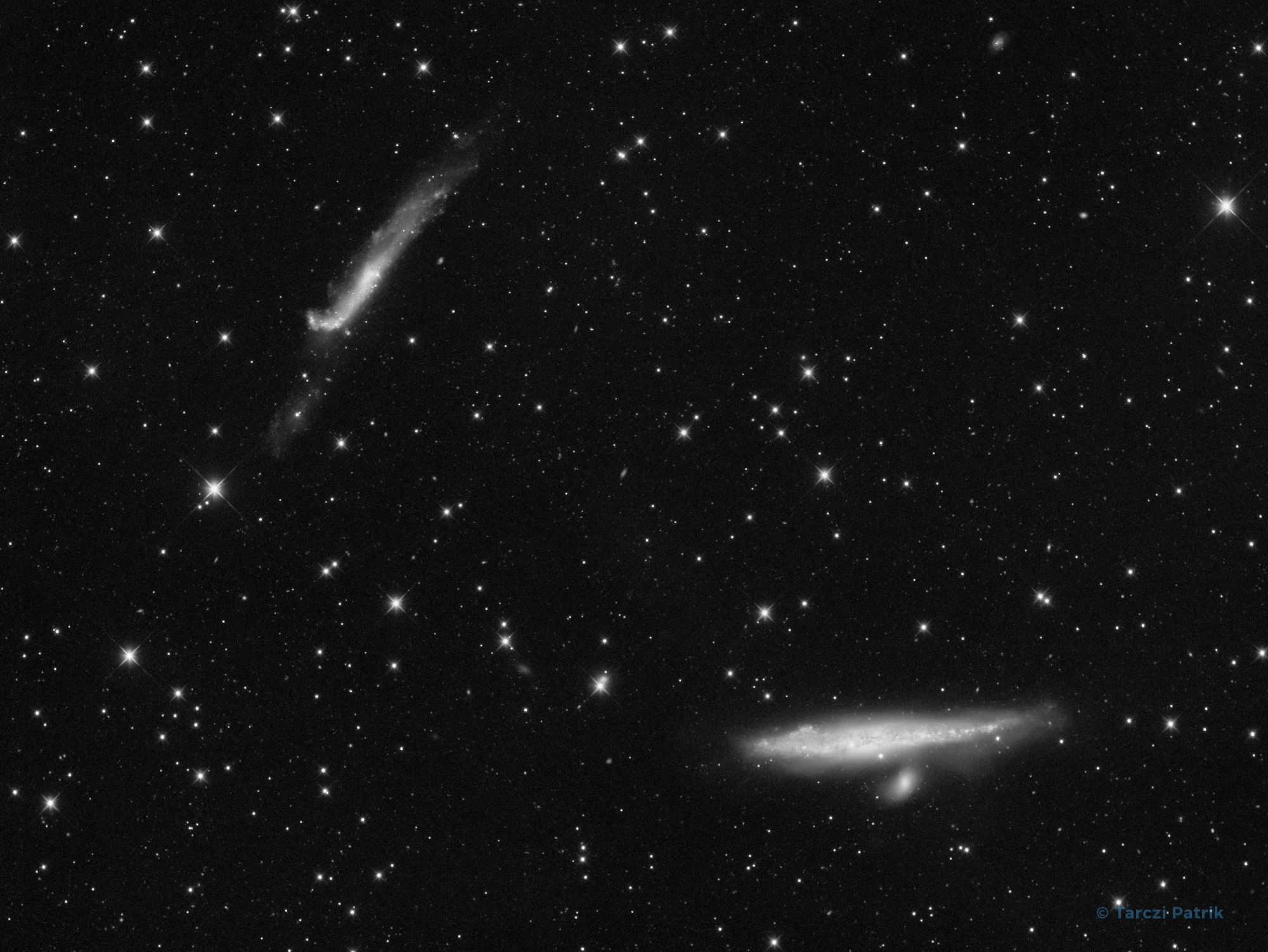
The Whale and The Hockey Stick
NGC 4631 and NGC4656
Technical data
| Instrument: | 173/700 Newton-astrograph (ZsIO), SkyWatcher comacorrector F/4 |
| Camera: | Atik One 6.0 |
| Filter: | Baader UV/IR block |
| Mount: | SkyWatcher NEQ6 Pro Synscan (modified) |
| Guiding: | Lacerta M-Gen autoguider, OAG |
Image data
| Exposure time: | L: 20 * 10 mins |
| Location, date: | Hungary, Izsákfa - 2016. April |
| Transparency: | 7/10 |
| Temperature: | 9 °C |
| FWHM: | 2.50" |
| Processing: | CCDStack, Registar |
Photo in progress:
Description
NGC 4631 is a big beautiful spiral galaxy seen edge-on (bottom right) only 25 million light-years away towards the small northern constellation Canes Venatici. This galaxy's slightly distorted wedge shape suggests to some a cosmic herring and to others the popular moniker of The Whale Galaxy. Either way, it is similar in size to our own Milky Way. In this gorgeous color image, the Whale's dark interstellar dust clouds, yellowish core, and young blue star clusters are easy to spot. A companion galaxy, the small elliptical NGC 4627, appears below the Whale Galaxy. At the top left is another distorted galaxy, the hockey stick-shaped NGC 4656. The distortions and mingling trails of gas detected at other wavelengths suggest that all three galaxies have had close encounters with each other in their past. The Whale Galaxy is also known to have spouted a halo of hot gas glowing in x-rays. Source: apod.nasa.gov
Technical data
| Instrument: | 173/700 Newton-astrograph (ZsIO), SkyWatcher comacorrector F/4 |
| Camera: | Atik One 6.0 |
| Filter: | Baader UV/IR block |
| Mount: | SkyWatcher NEQ6 Pro Synscan (modified) |
| Guiding: | Lacerta M-Gen autoguider, OAG |
Image data
| Exposure time: | L: 20 * 10 mins |
| Location, date: | Hungary, Izsákfa - 2016. April |
| Transparency: | 7/10 |
| Temperature: | 9 °C |
| FWHM: | 2.50" |
| Processing: | CCDStack, Registar |
Recommended photos
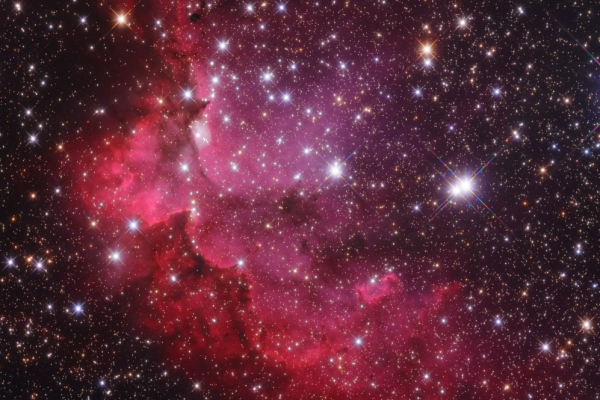
The Wizard Nebula
The Wizard Nebula, NGC7380 is located in constellation Cepheus, which lies roughly 8000 light-years away. It is categorized with number 142 by Stewart Sharpless in 1958.
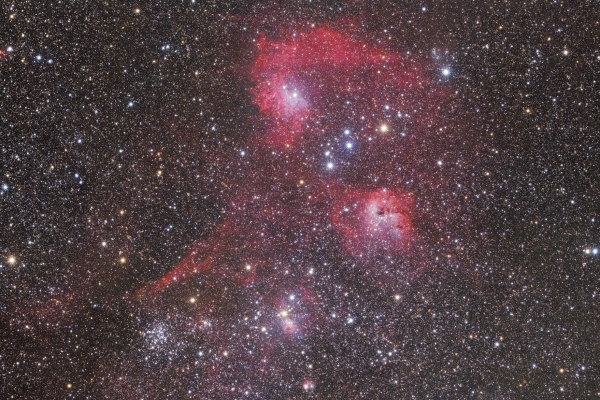
In the heart of constallation Auriga
Rich in star clusters and nebulae, the ancient constellation of the Charioteer (Auriga) rides high in northern winter night skies.
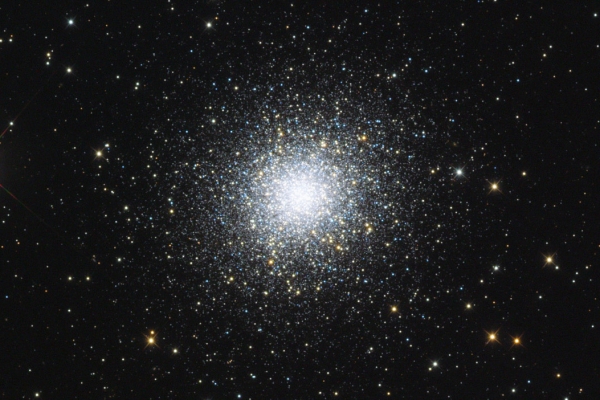
The Great Globular Cluster
The Great Globular Cluster is brighty shinning deep sky object in constellation Hercules.