


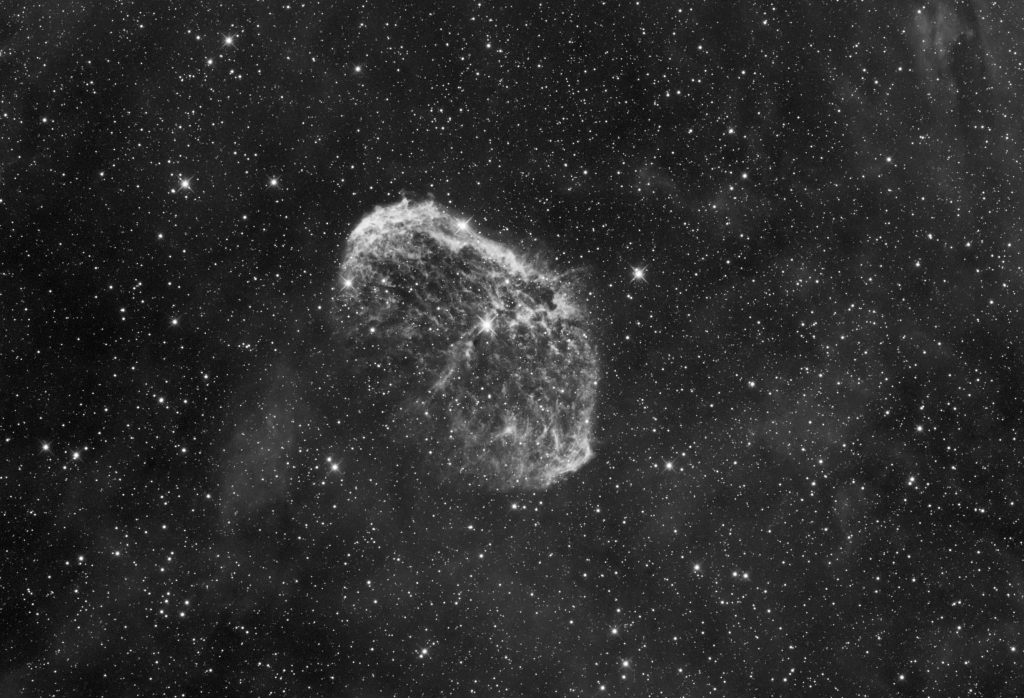
The Crescent Nebula
NGC6888
Technical data
| Instrument: | 173/700 Newton-astrograph (ZsIO), SkyWatcher comacorrector F/4 |
| Camera: | Atik One 6.0 |
| Filter: | Baader H-alpha 7nm |
| Mount: | SkyWatcher NEQ6 Pro Synscan (modified) |
| Guiding: | Lacerta M-Gen autoguider, OAG |
Image data
| Exposure time: | H-alpha : 7 x 10 mins |
| Location, date: | Hungary, Izsákfa - 2016. 08. 13 |
| Transparency: | 6/10 |
| Temperature: | 10 °C |
| FWHM: | 2.50" |
| Processing: | CCDStack, Registar, Photoshop |
Photo in progress:
Description
NGC 6888, also known as the Crescent Nebula, is a cosmic bubble about 25 light-years across, blown by winds from its central, bright, massive star. This sharp telescopic portrait uses narrow band image data that isolates light from hydrogen and oxygen atoms in the wind-blown nebula. The oxygen atoms produce the blue-green hue that seems to enshroud the detailed folds and filaments. Visible within the nebula, NGC 6888's central star is classified as a Wolf-Rayet star (WR 136). The star is shedding its outer envelope in a strong stellar wind, ejecting the equivalent of the Sun's mass every 10,000 years. The nebula's complex structures are likely the result of this strong wind interacting with material ejected in an earlier phase. Burning fuel at a prodigious rate and near the end of its stellar life this star should ultimately go out with a bang in a spectacular supernova explosion. Found in the nebula rich constellation Cygnus, NGC 6888 is about 5,000 light-years away. Source: apod.nasa.gov
Technical data
| Instrument: | 173/700 Newton-astrograph (ZsIO), SkyWatcher comacorrector F/4 |
| Camera: | Atik One 6.0 |
| Filter: | Baader H-alpha 7nm |
| Mount: | SkyWatcher NEQ6 Pro Synscan (modified) |
| Guiding: | Lacerta M-Gen autoguider, OAG |
Image data
| Exposure time: | H-alpha : 7 x 10 mins |
| Location, date: | Hungary, Izsákfa - 2016. 08. 13 |
| Transparency: | 6/10 |
| Temperature: | 10 °C |
| FWHM: | 2.50" |
| Processing: | CCDStack, Registar, Photoshop |
Recommended photos
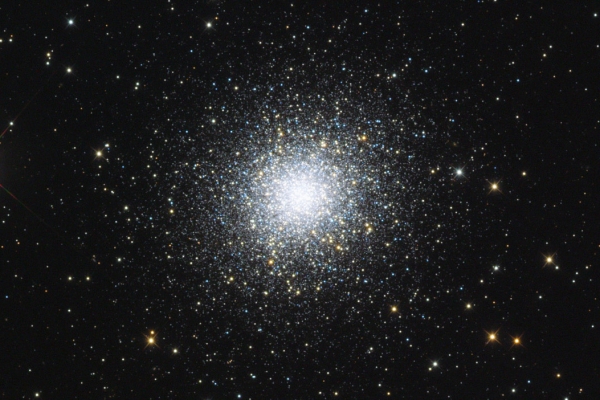
The Great Globular Cluster
The Great Globular Cluster is brighty shinning deep sky object in constellation Hercules.
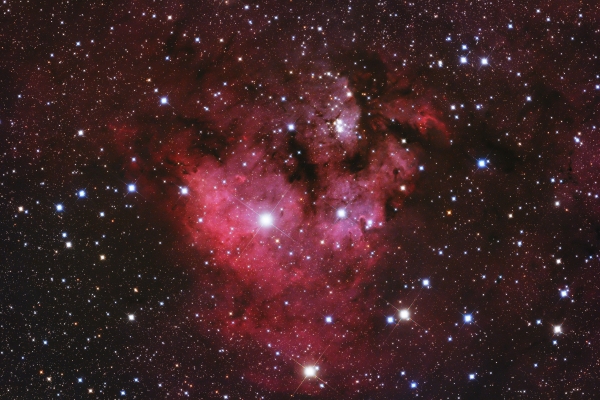
The Devil's Head Nebula
Towering pillars of cold gas and dark dust adorn the center star forming region of Sharpless 171.
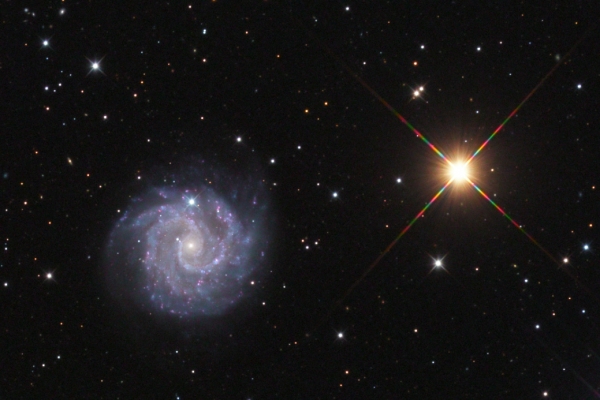
NGC3184 galaxy
NGC 3184 is a spiral galaxy approximately 40 million light-years away in the constellation Ursa Major. It has two HII regions named NGC 3180 and NGC 3181.